
Are Digital Art Prints Worth the Price? A 2026 Guide
Table of Contents
- What Determines the Real Cost of Digital Art Prints
- Production Costs vs. Profit Margins: Understanding the Price
- How to Display Digital Art Prints in Your Home
- Van Gogh Inspired Digital Art Prints: Quality and Authenticity
- Museum-Quality Standards: What Makes Prints Last
- How to Care for Art Prints and Preserve Their Value
- Digital Prints as Home Investment: Long-Term Value
- Frequently Asked Questions
Last Updated: September 20, 2026
What Determines the Real Cost of Digital Art Prints
When evaluating whether are digital art prints worth the price, you're asking what goes into making them and what creates the gap between a $20 poster and a $200 piece. That gap isn't arbitrary, it's built on measurable differences in materials, production standards, and longevity.
Real costs stem from file quality (300 DPI or higher captures far more detail), reproduction method (museum-quality printing on archival paper costs significantly more than standard inkjet), and framing. Plexiglass, UV-protective coatings, and sustainably sourced wood frames all affect longevity and final price.
Artist Ray van Buren sources materials that preserve the artist's vision: 250 gsm museum-quality archival paper paired with shatterproof plexiglass protection, the baseline for prints that won't fade or deteriorate within a few years.
Print-on-demand services like Gelato enable quality control without massive minimum orders. Each piece is produced to specification, you're paying for precision, not waste, making limited-edition digital prints economically viable for independent artists.
Production Costs vs. Profit Margins: Understanding the Price
Digital art prints have low production costs compared to traditional fine art, but that doesn't translate to a low price tag. Understanding why is essential to evaluating whether they're worth the price.
Per-unit production costs (paper, ink, labor) represent a fraction of retail price. Hidden costs drive the real expense: artist time, file preparation, color profiling, quality control, storage, payment processing, customer service, and returns handling.
Artist Ray van Buren's Van Gogh-inspired digital artworks include curation of five exclusive pieces, personal signatures for authentication, and FSC-certified oak and ash framing.
Direct-to-consumer sales allow healthier margins than wholesale or marketplace sales. Buying directly from an artist often represents better value than purchasing through aggregators, even at identical sticker prices.
The real question is whether materials, exclusivity, and longevity justify the price. A $199 premium wooden-framed print is fundamentally different from a $20 poster that yellows within a few years.

How to Display Digital Art Prints in Your Home
Displaying digital art prints effectively means understanding how light, space, and surrounding décor interact with your artwork. The display method you choose affects both how the print looks and how well it ages.
Natural light is beautiful but problematic, UV rays fade even archival-quality prints. Use indirect natural light supplemented with warm artificial lighting. Position prints away from direct sunlight, especially south-facing windows. Consider picture lights or recessed lighting to avoid glare on plexiglass.
Prints displayed above furniture anchor a room and become focal points. Large-format prints like Artist Ray van Buren's 70x70 cm pieces work best as statement pieces with breathing room, not as part of a gallery wall.
Neutral backgrounds (white, soft gray, warm beige) let artwork shine. Busy walls compete for attention. A calm background makes vibrant colors pop rather than clash.
Avoid bathrooms or kitchens where moisture fluctuates. Climate-controlled living rooms or bedrooms are ideal. Temperature swings cause frame expansion and contraction, stressing the mounting system.
Hang prints at eye level (57-60 inches to center). For large pieces above furniture, aim for 8-10 inches of clearance to create visual balance.
Van Gogh Inspired Digital Art Prints: Quality and Authenticity
Van Gogh-inspired digital art prints occupy an interesting space in the art market. They're not original paintings, but they're also not mass-produced reproductions of existing work. When done well, they're contemporary interpretations that honor the master's style while adding new perspective.
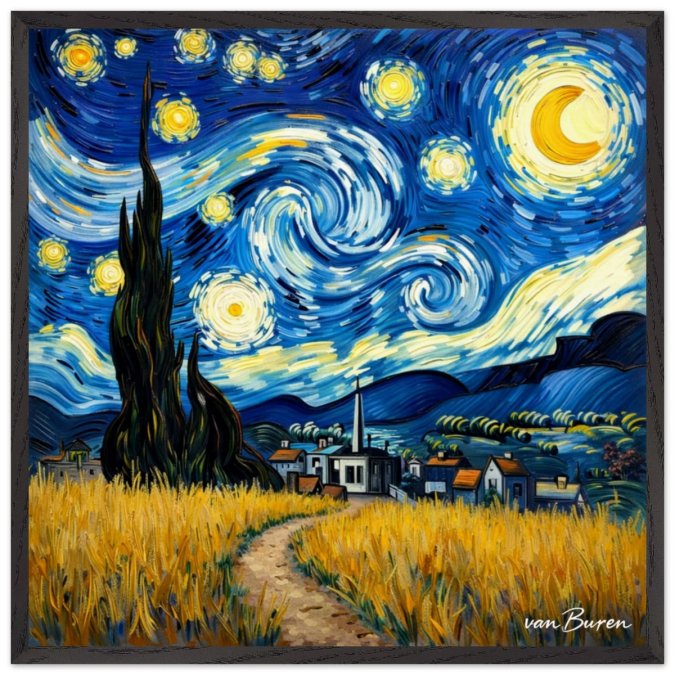
Quality in Van Gogh-inspired digital art comes down to how faithfully the digital artist captures the emotional intensity and technical precision of Van Gogh's work. The brushwork, those characteristic swirls and directional strokes, must feel intentional, not random. The color palette should evoke the same emotional response as the original style: turbulent energy, depth, movement.
Authenticity in this context means several things. First, the piece should be created as original digital art, not a filter applied to a photograph. Second, it should be signed or attributed to the artist who created it. Artist Ray van Buren's collection includes personally signed pieces, which adds a layer of authentication and exclusivity. Third, the print should be produced at museum-quality standards that preserve the artist's original intent.
When evaluating a Van Gogh-inspired print, look for evidence of intentional artistic choices rather than algorithmic generation. The composition should have balance and purpose. The color transitions should feel deliberate. The overall piece should work as a standalone artwork, not as a derivative that requires knowledge of the original to appreciate.
The difference between a high-quality Van Gogh-inspired print and a lower-quality alternative often comes down to the file resolution and color profiling. A 300 DPI file captures the subtle gradations and texture that make the piece feel alive. Lower resolutions flatten the image and lose the dimensional quality that makes these prints worth displaying.
Premium Wooden Framed Poster With →
Museum-Quality Standards: What Makes Prints Last
Museum-quality is more than marketing language, it's a set of measurable standards that determine how long a print remains vibrant and undamaged.
The paper itself is the foundation. Museum-quality paper is typically acid-free and lignin-free, which prevents yellowing and brittleness over time. The weight matters too. A 250 gsm (110 lb) paper is thick enough to feel substantial and durable, while lighter papers can warp or tear more easily. The finish, matte, glossy, or semi-gloss, affects both appearance and longevity. Matte finishes reduce glare and feel more traditional, while glossy finishes enhance color saturation but show fingerprints more readily.
The ink used in museum-quality printing is pigment-based rather than dye-based. Dye-based inks fade much faster, especially when exposed to light.
Color profiling during printing is critical. A properly color-profiled print accurately reproduces the artist's intended colors. Without proper profiling, reds shift toward orange, blues become purple, and the overall piece looks off. This is why printing through services like Gelato, which use professional color management, matters. Each print is calibrated to match the digital file as closely as possible.
The protective layer adds another dimension to longevity. Plexiglass shields the print from dust, moisture, and accidental damage. UV-protective plexiglass filters harmful rays that fade prints over time. This is why Artist Ray van Buren's framed prints include shatterproof plexiglass, it's not just about protection, it's about preservation.
Frame materials contribute to longevity too. Wood frames made from sustainably sourced oak or ash are more stable than cheaper alternatives. The thickness of the frame (20mm versus 14mm) affects how well it resists warping and stress. The mounting system, how the print is attached to the backing, should allow for slight expansion and contraction without buckling the paper.
How to Care for Art Prints and Preserve Their Value
Proper care extends the life of your digital art prints and maintains their aesthetic value. A few simple practices make a significant difference over years and decades.
Dust regularly but gently. Use a soft, dry cloth or a soft-bristled brush to remove dust from the plexiglass surface. Never use water or cleaning solutions on the print itself, as moisture can seep behind the plexiglass and damage the paper. For the plexiglass, a microfiber cloth works best, it won't scratch or leave streaks.
Avoid direct sunlight and excessive heat. Position prints away from south-facing windows where UV rays concentrate. If you must display a print in a sunny spot, consider using UV-filtering window film to reduce light intensity. Keep prints away from heat sources like radiators, fireplaces, or direct air conditioning vents, as temperature fluctuations cause the paper and frame to expand and contract.
Monitor humidity levels. Ideally, keep your home between 30-50% relative humidity. Too much moisture encourages mold and warping; too little causes the paper to become brittle. If you live in a very humid climate, a small dehumidifier in the room with your prints can help. In dry climates, a humidifier prevents excessive drying.
Handle prints carefully if you need to move or reposition them. Always support the frame from the bottom, never by the plexiglass. If you're transporting a print, wrap it in acid-free paper and place it flat or at an angle, never standing upright, to prevent stress on the mounting system.
Store prints properly if you're not displaying them. Use acid-free tissue paper and storage boxes. Keep them in a climate-controlled space away from moisture, pests, and extreme temperature swings. Don't stack multiple prints directly on top of each other; separate them with acid-free cardboard or foam board.
Inspect your prints periodically for signs of damage or deterioration. Look for yellowing, foxing (brown spots), or any separation between the print and the backing. If you notice damage, address it early. Small issues can often be fixed before they become serious problems.
Digital Prints as Home Investment: Long-Term Value
Digital art prints occupy an unusual position in the investment landscape. They're not traditional fine art investments, but they're not disposable décor either. Understanding their value proposition requires looking beyond the initial purchase price.
The primary value of a digital art print lies in how it enhances your living space and personal enjoyment.
Frequently Asked Questions
What factors determine the value of a digital art print?
Several factors affect digital art print value: paper quality (museum-grade archival paper resists fading), resolution and DPI (high-resolution files prevent pixelation when enlarged), frame materials (responsibly sourced wood adds durability and aesthetic value), artist signature and provenance (authenticated, signed pieces hold stronger market perception), and production method (Gelato printing at museum standards ensures color accuracy and longevity). Limited edition status and artistic integrity also influence perceived value versus mass-produced alternatives.
How does museum-quality printing affect the longevity of digital art prints?
Museum-quality printing uses archival-grade materials designed to last without fading. The paper is acid-free, uncoated, and typically 250 gsm weight with proper color profiles applied during production. High-quality matte finishes and protective plexiglass shields prevent UV damage and physical wear. When combined with proper care, museum-standard prints maintain their color vibrancy and artistic integrity far longer than standard commercial prints.
What is the difference between a mass-produced print and a premium digital art print?
Mass-produced prints use thin paper, basic color profiles, and minimal protection. Premium digital art prints use 250 gsm archival paper, precise color management, shatterproof plexiglass protection, and sustainably sourced frames. Premium options include artist signatures, unique wood grain frames, and ready-to-hang installation. The upfront cost is higher, but premium prints preserve artistic integrity and resist fading.
Are digital art prints considered a good investment for home decor?
Yes, when purchased at museum-quality standards. Digital prints are accessible to broader audiences. Signed, limited-edition digital prints with authenticated provenance and premium framing hold stronger collector appeal than mass-produced alternatives.